Cloud economics assessment – a pathway to cost / benefit analysis for cloud migration

As highlighted in our earlier thought leadership piece “Empowering insights and innovation through cloud-based data and analytics modernization”, a structured approach to migrating data and analytics solutions to cloud, informed by a thorough assessment of costs and benefits associated with the migration is critical to the execution of a successful migration initiative. While on the surface, cloud promises to be a cost-effective alternative to traditional on-prem data and analytics solutions, in reality the overall cost / benefit equation depends on several factors, which we’ll explore in detail here.
Understanding costs:
One of the major drivers of increasing cloud adoption is the promise of cost savings. However, identifying impacted on-premise cost items and understanding different cloud costs categories can be challenging. Before initiating a cloud migration, it is useful to develop a holistic understanding of direct and indirect costs associated with your on-prem IT infrastructure, and corresponding costs when you move the on-prem workloads to cloud. This in turn helps develop a Total Cost of Ownership (TCO) comparison associated with your cloud migration initiatives. Traditionally, enterprises lack effective IT cost transparency processes and systems which are essential for effective on-premise vs cloud TCO comparison. Direct costs are fairly obvious, and are easy to consider during TCO calculations. However, indirect costs are not as straightforward to uncover and quantify. The illustration below summarizes the broad categories of cost drivers for both and on-prem data & analytics solution and an equivalent cloud setup.
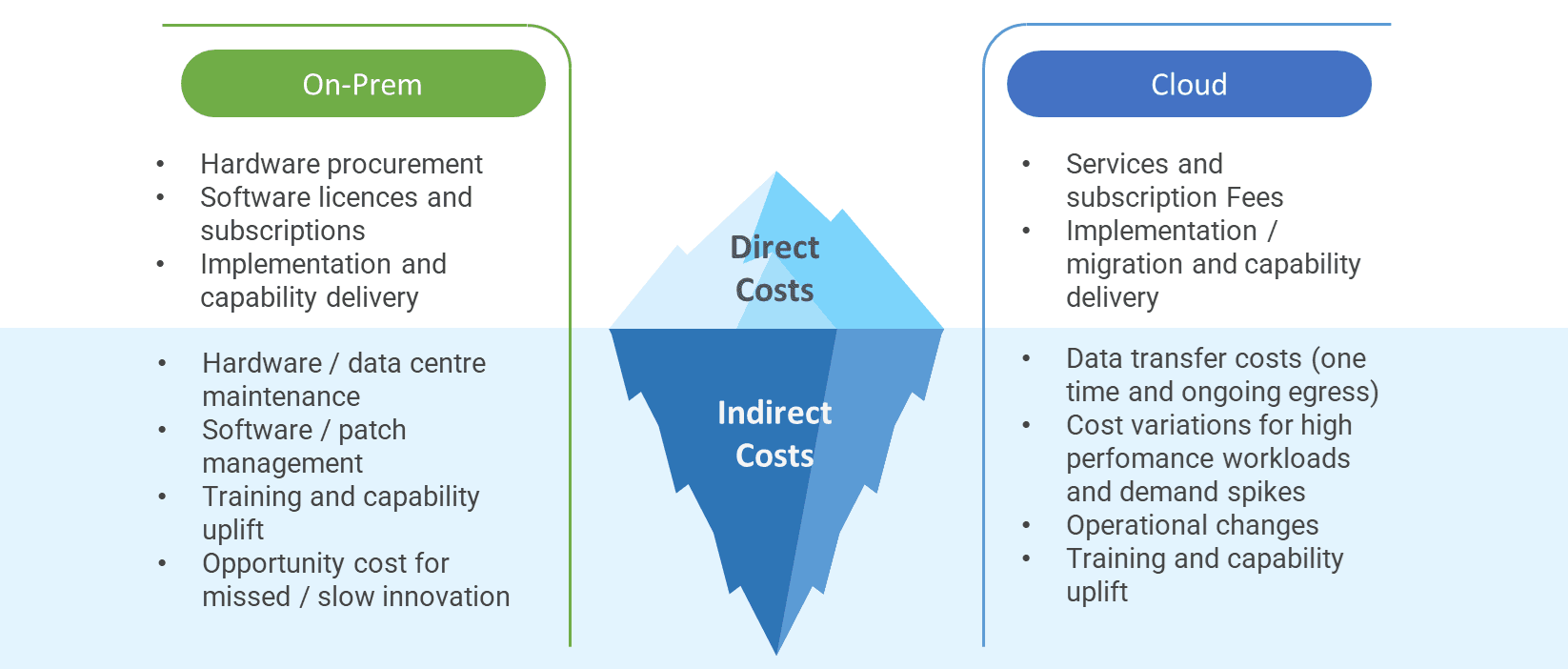
Direct costs for on-premises solutions are primarily driven from the procurement of hardware and software components, and the costs incurred in building specific applications using these components. Indirect costs are mostly attributable to the ongoing running costs associated with the management of the data centre hosting the hardware (real estate, electricity, manpower etc.), software patching and ongoing training and skill uplift across the organization. Another useful area to consider is the opportunity cost related to missed opportunities for innovation and slow uptake of new capabilities due to inherent limitations with enhancement and scaling of on-prem infrastructure. Calculating this opportunity cost can be challenging due to the intangible nature of innovation and its potential impacts, but it can be a significant factor for a more objective TCO assessment. By systematically identifying potential innovation opportunities (e.g. processes automation, customer centricity, AI/ML, GenAI etc.), estimating their potential gains, and understanding the financial impacts through quantitative methods (e.g. industry benchmarking, scenario analysis etc.) and qualitative impact analysis (e.g. organizational learning, employee retention and morale etc.), organizations can better understand the true cost of missed opportunities. We will cover this in more detail at a later time.
Direct costs for an equivalent cloud-based solution are primarily driven from the cloud services being used and the related implementation costs. Below are the key considerations to accurately estimate the cloud related costs for an informed TCO calculation:
- Develop a clear understanding of the on-prem data volumes and workloads (including SLAs, performance and response time requirements) – assess the current state
- Carefully identify and map different cloud services to the corresponding on-premise components considering performance, compliance and security requirements – define the target architecture
- Understand the different cost drivers and pricing models for each cloud service and impacted cost items for corresponding on-premise components – calculate cloud costs using the volumetrics from the assessment and the target architecture
- Determine the impact of migration on the existing licenses – can net savings be leveraged through migrating existing product licenses to cloud?
- Determine the cost of one-time migration based on the current state assessment – development costs for data migration and integration
Cloud solutions can incur indirect costs through on-going egress fees for data retrieval and varying performance requirements associated to changing workloads and user demands. High performance workloads may require premium cloud services and configuration changes which can be costly in the long run, if not planned for in advance. In addition to ongoing training and skill uplift across the organization, moving to the cloud requires potential changes to existing operating model and accounting and technology management processes, which usually requires a holistic approach to organizational change management. These factors should also be taken into consideration for TCO estimations related to a cloud-based solution.
Benefits quantification:
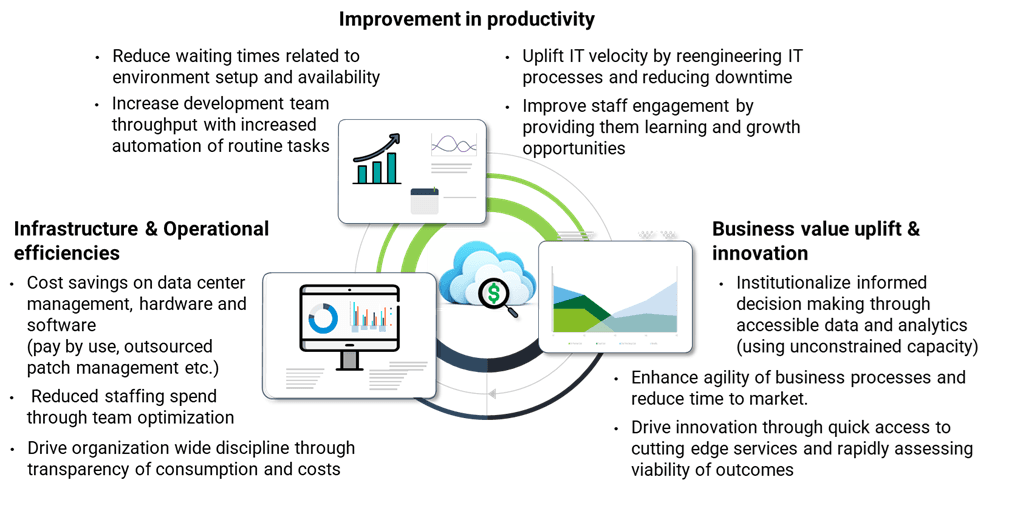
Now that we have established a baseline model for determining comparative costs for both on-prem and cloud solutions, the next step is to quantify net benefits related to migrating your data and analytics environment to cloud. This, in conjunction with the estimated TCO, determines whether or not a cloud migration business case makes sense for an organization. Based on our experience, there are three main areas for benefits realization:
- Operational efficiencies achieved through optimization of infrastructure. This results in hard cost savings in the form of avoiding costs related to un-used capacity or over-subscription in on-prem solutions, and through outsourcing infrastructure management to cloud providers. Quantification should consider:
- Savings from reduced spending on hardware and data centre costs
- Reductions in software maintenance and support contracts
- Potential reduction in staffing costs due to decreased need for infrastructure management
- Improvement in productivity as development lifecycle can be optimised through quick provisioning of infrastructure and services leveraging cloud availability and scalability options. Quantification should consider:
- Time savings for IT staff and other employees
- Automation of routine tasks
- Reduction in downtime from improved reliability
- Potentially lower turn-over of IT staff
- Unlocking new business value generation opportunities through enhancing the agility of business processes, quickly enablement of analytics-based decision making and increasing accessibility to state-of-the-art innovation for organizations. Quantification should consider:
- Benefits from autoscaling and faster deployment of new capabilities
- Financial impact of reduced time to market for new products
- Revenue / cost savings from leveraging advanced cloud services (e.g. AI / ML)
The illustration below summarizes these benefit quantification areas.
Bringing it all together:
Let us now look at both the TCO and benefits together in the context of an end-to-end data and analytics cloud migration initiative. Such a cloud migration initiative normally goes through four different lifecycle stages:
- Initial migration to cloud: This includes one time setup of the cloud platform, migration of historical data (based on the preferred migration pattern i.e. rehost, re-platform, refactor), and development of ongoing data integration and visualization capability corresponding to the on-prem setup.
- Parallel run and transition: Once the initial migration is done, the cloud solution runs in parallel with the on-prem solution. During this stage, organizations start to transition the user community to the cloud-based reporting and analytics capability while carrying out reconciliation (between old and new reports) and user trainings to enable the effective use of the newly developed capability. In addition, this stage also includes the wider cloud related operating model changes across the organization. This stage culminates at the eventual cutover of the on-prem solution, with all users successfully transitioned to the cloud solution, and treatment options for on-prem applications finalised and executed.
- New capability and use cases: This phase starts to unlock new use cases and associated capabilities to the wider business community. By this time, critical datasets are already in the cloud and organizations are usually increasing their maturity regarding the use of cloud services. As new datasets and workloads are developed on the cloud solution, the organization also comes to term with managing cloud costs.
- Optimised and cloud native: This is the final phase in the cloud migration lifecycle, and it signifies a mature and cloud native organization, where the use of cloud services is embedded within the organization, the operating model to effectively manage cloud solutions has matured, and proactive cloud management and optimization capabilities are in place.
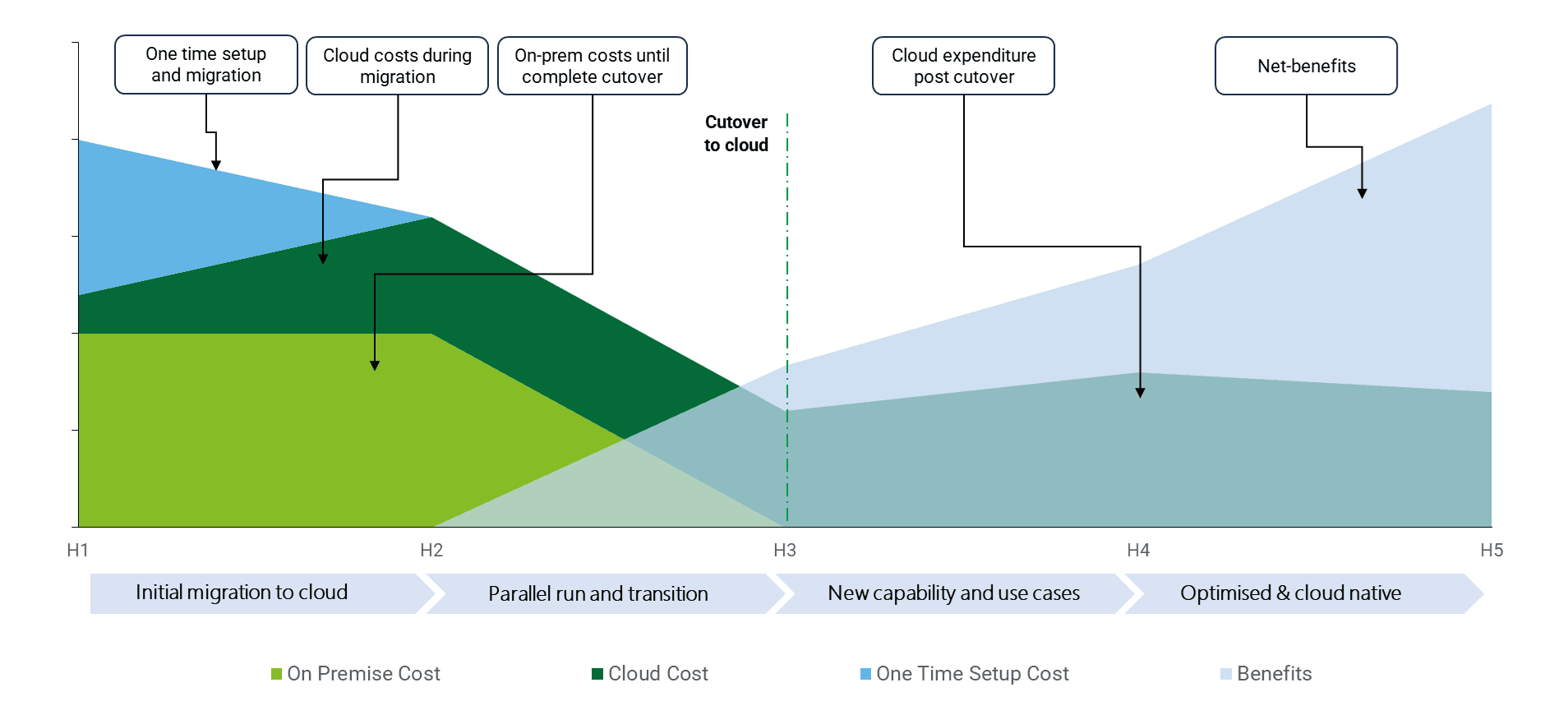
At the start of the cloud migration, organizations will likely see a spike in total expenditure due to the additional effort involved in build out and migration activities. During the first phase, cloud costs will increase progressively until migration completion as new environments and services may be provisioned over time. It is also important to note that in the first two lifecycle stages, the organization will incur the costs of both on-prem and cloud environments — once the cutover is complete the on-premise environments will be decommissioned and expected benefits associated with infrastructure optimization will be realized. After cutover, cloud costs are also expected to fluctuate as additional users and use cases are onboarded. As organizational maturity increases, enhanced monitoring and accounting capabilities can be leveraged to optimize overall service utilization and to provide the opportunity to tap into bulk discounts and introduce consumption-based chargeback models leading to a potential reduction in IT spend.
Understanding and evaluating costs and benefits across each migration stage enables organizations to plan such initiatives upfront, and minimize the risk of cost over runs in the long term. Conducting a holistic cost / benefit analysis for cloud migration of a data and analytics solution is essential for making informed, strategic decisions. This comprehensive approach ensures a detailed understanding of both initial and ongoing costs, helps identify and mitigate potential risks, and quantifies both tangible and intangible benefits. It aligns the migration with business goals, secures stakeholder buy-in, and promotes long-term sustainability by future-proofing and optimizing costs. Overall, it provides a clear, data-driven rationale that maximizes value and minimizes risks, ensuring the migration supports the organization's objectives effectively.