Empowering insights and innovation through cloud-based data and analytics modernization

In today’s ever evolving and digitally enabled economic landscape, technology modernization is essential for businesses striving to maintain their competitive edge. Data and analytics as a discipline, is at the heart of this modernization, as it enables organizations to derive actionable insights, make informed decisions, and optimize operations. With the explosion of data from various sources—such as customer interactions, social media, IoT devices, and transactional systems—organizations need robust analytics capabilities to harness this information effectively.
A key part of this modernization involves migrating legacy data and analytics solutions to the cloud. This shift provides many advantages, such as improved scalability to handle large volumes of data, cost savings by reducing the need for on-premises infrastructure, and enhanced data management capabilities that streamline data integration, storage, and processing. Additionally, cloud-based analytics platforms offer advanced tools and technologies, such as machine learning and artificial intelligence, which can further drive innovation and competitive advantage.
Before we explore a holistic approach to migrating data & analytics solutions and workloads to cloud, let’s have a quick look at the prevalent cloud adoption trends in the context of data and analytics:
- Rehost (“lift & shift”) – hosting the existing technology stack, architecture and applications as-is on cloud. This is mostly applicable where organizations are looking to move on-prem, in-house databases and data marts to the cloud quickly, with minimal changes to the existing setup. This is often looked to as a faster and cheaper option to achieve alignment with cloud-first agendas. While this offers speed, this approach does not fully harness majority of cloud’s benefits e.g. autoscaling.
- Re-platform – similar to rehosting applications on the cloud, but it does involve some modification of the application / database to take advantage of the new cloud infrastructure, without changing the underlying application architecture e.g. migrating an on-prem SQL server to a managed database services in the cloud.
- Refactor – encompasses re-imagining how an application is architected and developed, typically using cloud-native features. This is typically driven by a strong business need to add features, scale, or performance that would otherwise be difficult to achieve in the application’s existing environment e.g. re-design of an existing data-warehouse solution using cloud services.
- Green field – pertains to the development of a new enterprise data & analytics solution and supporting applications, utilizing cloud native architecture and services to address specific business use cases.

Note: Contemporary literature also refers to two additional patterns i.e. Retain (retention of on-prem application as-is), and Retire (decommissioning of obsolete applications / datasets). We see both of these as treatment options for applications, subject to the cloud adoption pathway chosen by an organization. Hence, they have not been explicitly included here.
In recent years, we’ve seen a considerable number of organizations embark on cloud modernization initiatives. The success rate of such initiatives for data and analytics varies, but industry reports suggest that it hovers around 60 - 70%. According to Gartner & McKinsey, while many organizations successfully migrate their data and analytics workloads to cloud, a number of such initiatives face significant issues that can lead to delays, cost overruns, or even failure to meet intended business objectives.
The migration process is intricate and demands meticulous planning and thoughtful consideration, more so where the complexity of the migration is higher i.e. refactoring scenarios. Organizations must start with developing a clear understanding of the core business drivers for their transition to cloud. Additionally, they must address various challenges, including data security, compliance, and ensuring data integrity throughout the transition. Having a structured migration approach upfront, underpinned by a clear understanding of business drivers, implementation considerations and cost/benefit analysis makes the journey ahead a lot more streamlined. Below, we provide a consolidated approach to streamline the execution of such initiatives, based on a combination of best practices and our experience of helping organizations with similar initiatives.
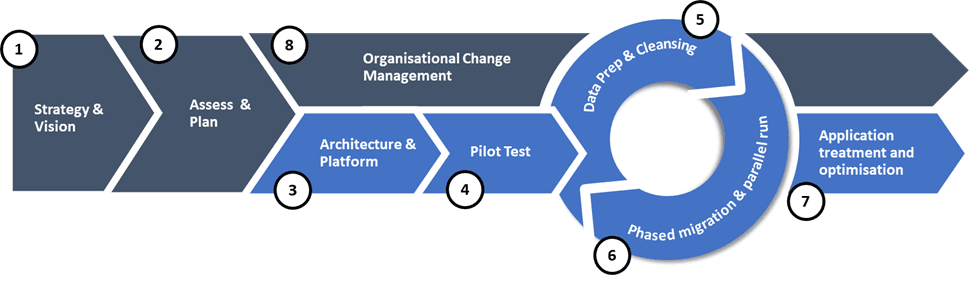
- Vision and intended business outcomes: Begin with developing a clear vision of the core business outcomes sought from migrating data & analytics workloads to cloud. Developing a holistic modernization business case is key to developing a clear and uniform understanding in this regard. Research indicates that organizations committing to outcomes driven cloud adoption initiative, underpinned by strong top-down buy-in are more likely to achieve successful outcomes from their cloud investments.
- Assessment and planning: Conduct a thorough assessment of the existing data infrastructure and analytics solutions. Identify and prioritize the data sets, applications, and workloads that need to be migrated. Develop a detailed migration strategy that includes a timeline, resource allocation, and risk management plan.
- Architecture and platform setup: Select a cloud provider that aligns with your organization's needs. Consider factors such as data storage options, analytics tools, integration capabilities, security measures, and support services. Develop a detailed architecture for the target platform using cloud services, underpinned by the core business drivers and use cases, and data security and compliance requirements. Set up, provision and test the target platform components and services, and create environments to support development, test and release activities.
- Pilot testing: Conduct a pilot migration with a small subset of data and applications. This helps identify potential challenges and allows the team to refine the migration process. Pilot testing ensures that the migration strategy is robust and can handle real-world scenarios.
- Data preparation and cleansing: Before migration, ensure that the data is clean and well-organized. Data cleansing involves removing duplicates, correcting errors, and standardizing data formats. This step is crucial to avoid propagating issues to the new environment.
- Phased migration of workloads and parallel run: Execute the migration in phases to reduce risk. Monitor the migration process closely to identify and address any issues promptly. Use automated tools to track progress and ensure data integrity and ongoing reconciliation of data sets and reports between the cloud and on-prem setup, while running workloads in parallel across the two environments. Incrementally transition users towards cloud-based workloads to minimize potential downtime.
- Post-Migration application treatment and optimization: Once the migration is complete, identify the appropriate treatment options (retain or retire) for existing applications, reports and data sets. In addition, iteratively optimize the cloud environment for performance and cost efficiency. This includes tuning analytics applications, configuring security settings, and ensuring that data access controls are in place.
- Change management and transition: This needs to be looked at as an ongoing activity, running in parallel throughout the cloud migration initiative. This encompasses developing a holistic change management strategy that includes revisiting operating models, uplifting data management and governance capabilities, redesigning processes, and reskilling teams to handle cloud technologies effectively.
Migrating data and analytics solutions to the cloud is a strategic move that can drive significant business benefits. However, it requires careful planning and consideration of various factors to ensure a successful transition. By following a structured migration approach and conducting a thorough cost/benefit analysis, organizations can modernize their data infrastructure, leverage advanced analytics capabilities, and achieve greater operational efficiency and agility.
About the author

Brett Willoughby
Senior Consultant
Breaks down complex data systems into clear, actionable insights