Responsible AI by Design: A Framework for Execution

Leaders want AI’s upside without the reputational, legal, or safety incidents that make headlines. The answer isn’t another values manifesto, but a practical, auditable operating system that links roles, controls, and evidence to the decisions your organization makes every day.
The problem to solve
The most common AI failures do not come from a single model in a lab. They occur in production, when data drifts, users try to exploit prompts, or staff cannot explain the basis of an adverse decision. Typical failure modes include misuse of personal data, unfair outcomes for some groups, hallucinated or unattributed claims in generative systems, security exposure from prompt‑injection or data exfiltration, and gaps in accountability when something goes wrong. These are management system issues as much as they are model issues.
Regulators are taking the same view. The European Union’s Artificial Intelligence Act introduces a risk‑based regime with explicit obligations for higher‑risk systems, including risk management, data governance, technical documentation, human oversight, and post‑market monitoring [1]. The U.S. National Institute of Standards and Technology defines AI risk management as a lifecycle discipline: Govern, Map, Measure, and Manage. In 2024 it also released a generative AI profile that sets out concrete practices [2][3]. ISO/IEC 42001 creates a certifiable management system for AI, echoing the way ISO 27001 professionalized cybersecurity programs [4]. For boards and executives, the implication is direct: treat ethical AI as a capability that sits next to security and privacy, and measure it with the same discipline.
National guidance points in the same direction. The UK Information Commissioner’s Office prioritizes fairness, transparency, and proportionality for AI systems that use personal data. Australian guidance operationalizes eight ethics principles to support public-sector assurance and procurement. Those expectations translate well into a practical operating model for any large organization [6][7][8].
A practical framework
A practical framework for ethical AI has three layers. First, direction. The organization should adopt a short, plain policy grounded in widely recognized principles: human benefit, fairness, transparency, robustness, and accountability. The OECD formulation is a credible anchor [5]. Second, structure. Maintain an inventory of AI systems and classify each use case by intended purpose and potential impact on people, safety, and the business. Oversight should be proportionate to risk. High‑risk uses require deeper documentation, testing, and human‑in‑the‑loop approval. Limited‑risk uses can rely on lighter controls with automation and routine checks [1]. Third, proof. Design delivery pipelines so that evaluation, documentation, and approvals are produced automatically. Auditors and customers should be able to review the same artifacts that engineers use to operate the system. This is how NIST’s “measure” and “manage” concepts show up in practice [2][3].
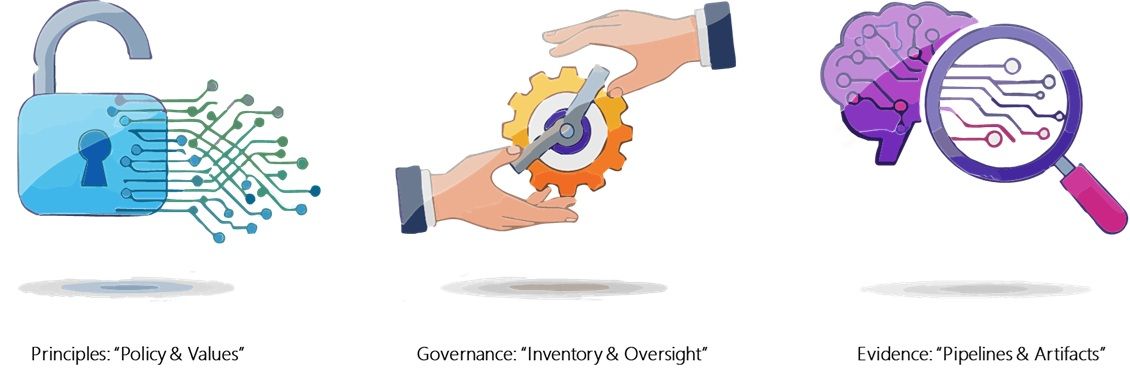
Design approach: connect standards, enforcement, and accountability
Set the standards (core concepts). Define what you mean by ethics, privacy, explainability, and accountability in plain language. Be explicit about common dilemmas such as accuracy versus fairness or personalization versus privacy, and the compensating controls you will use. This gives teams a shared definition of “acceptable.”
Enforce the standards (pipeline). Build those definitions into the delivery workflow. The pipeline records data provenance and purpose, runs the right evaluations for the decision at hand, generates model cards and data sheets as part of CI/CD, and stress-tests generative systems. Where the standard calls for human judgment, the workflow routes cases for review and captures overrides. Evidence is produced as a by-product of shipping, not as a separate exercise.
Own the outcomes (control plane). For each use case and model version, name the owners in product, engineering, risk, and legal. Maintain an AI register and a simple control catalogue that maps risk tiers to required tests, documents, and approvals. An AI review board resolves exceptions and makes promotion decisions. This makes it easy to answer, “who approved what, based on which evidence.”
Why this works. The concepts reduce ambiguity. The pipeline turns policy into behaviour and creates an audit trail by default. The control plane ensures timely decisions and accountability. Together they let you scale AI with confidence while meeting regulatory expectations.
Execution roadmap: prioritize, automate, and assure
A two‑phase plan gets most organizations to a reliable baseline.
Phase 1 : Set foundations. Approve the policy and risk taxonomy. Launch an AI system register. Select two use cases to pilot the lifecycle—one high risk and one limited risk. Build evaluation, documentation, and approvals into CI/CD so artifacts are created at build time. Draft incident runbooks and rehearse a tabletop exercise.
Phase 2 : Industrialize and assure. Turn manual checks into code wherever possible. Automate fairness and robustness tests, adversarial testing for generative systems, and promotion gates. Publish a simple assurance calendar. Align supplier due diligence with your controls, including transparency on foundation models, training-data provenance, and update policies. If certification will unlock customers or reduce audit load, map controls to ISO/IEC 42001 and close the gaps [4].
On completion of the two phases, your team should be able to generate on demand a concise evidence pack for any production model: model card, data sheet, evaluation results, lineage, approvals, and runtime telemetry.
Sector nuance
Different sectors face distinct realities, so the emphasis shifts with context.
In telecommunications and digital services, the priority is fairness and clarity. Pricing and eligibility must be explainable, consent and retention for communications metadata must be tight, and any customer-impacting decision should come with a plain-English rationale. Where customers interact with copilots, build in source citation and tone controls, and route sensitive or ambiguous cases to a human.
In the public sector, trust is earned through openness and access. Transparency, contestability, and inclusion need to be visible in practice: publish understandable summaries where appropriate and maintain assisted-digital channels for people who cannot or should not use automated paths.
In healthcare and financial services, the tolerance for error is lower. Strengthen data governance and validation, adopt conservative thresholds for performance and fairness, keep humans in the loop for consequential outcomes, and be ready for external audits and clear incident disclosure when issues arise.
Mindset shift
Ethical AI is not a brake on innovation. It is how leadership earns the right to scale it. It turns ambition into durable advantage by pairing clear standards with evidence that is produced as work gets done. When the delivery pipeline generates verifiable artifacts for every release, teams move faster with fewer surprises, customers gain confidence, and regulators can examine and endorse the program. The result is not only compliance, but repeatable performance: better decisions, lower risk, and faster time to value. Leaders who make this operating shift do not slow innovation; they unlock it and sustain it at enterprise scale.
References:
5. Organisation for Economic Co‑operation and Development. (n.d.). OECD AI Principles
6. Information Commissioner’s Office. (n.d.). Guidance on AI and data protection
About the author

Laura Bennett
AI Consultant
Writes about the future of AI with a pragmatic lens on adoption